

EXPRESS
EXpressing in PREmaturity – Simple interventionS: Does a guided relaxation audio track increase yield of expressed milk in mothers of very preterm infants? A randomised controlled trial and nested exploratory work
Trial started: 2021 Trial ended: 2023
Summary
Objectives
To determine whether a self-directed audio relaxation and lactation-specific visualisation increases milk quantity after a very premature birth.
Methods
An unmasked, randomised, controlled trial conducted in four UK neonatal units involving 132 participants. Eligible women had given birth to one or two infants between 23+0 and 31+6 weeks' gestation. The intervention was a 12-minute voice recording including breathing exercises, muscle relaxation and lactation-specific visualisation.
Outcome measures
Primary outcome: The highest 24-hour breastmilk weight expressed on any of day 4, day 14 or day 21 after birth.
Results
Mean birth gestation was 27.8 weeks (SD 2.4), with 26% of participants giving birth under 26 weeks (34/132). The adjusted mean difference in the primary outcome was 73.9 g (95% confidence interval ?61.7 to 209.5; p = 0.28). The adjusted mean difference in Spielberger State-Trait Anxiety Index was ?1.9 (95% confidence interval ?8.2 to 4.3; p = 0.54). The majority of participants in the relaxation group felt the intervention was relaxing (32/42, 76%).
Conclusions
There was no beneficial effect of this relaxation intervention on milk quantity. Mothers of very premature infants may value relaxation interventions, but they are unlikely to have a large effect on milk quantity.
Adapted from: Levene I, Hardy P, Bell JL, et al. Lactation-focused audio relaxation versus standard care for mothers of very preterm infants (the EXPRESS randomised clinical trial). Pediatric Research. 2025;97:2035–2044. https://doi.org/10.1038/s41390-024-03577-7. Licensed under the Creative Commons Attribution 4.0 International (CC BY 4.0) Licence (https://creativecommons.org/licenses/by/4.0/). Adapted for presentation on this website.
Show Publications
-
Levene I, O'Brien F, Fewtrell M, Quigley MA. The relationship of early expressed milk quantity and later full breastmilk feeding after very preterm birth: A cohort study. Maternal & Child Nutrition. 2024;n/a(n/a):e13719.
https://doi.org/10.1111/mcn.13719 - Levene I, Fewtrell M, Quigley MA, O’Brien F. The relationship of milk expression pattern and lactation outcomes after very premature birth: A cohort study. PLoS One. 2024;19(7):e0307522.
https://doi.org/10.1371/journal.pone.0307522 - Levene I, Quigley MA, Fewtrell M, O’Brien F. Does extremely early expression of colostrum after very preterm birth improve mother’s own milk quantity? A cohort study. Archives of Disease in Childhood - Fetal and Neonatal Edition. 2024;109(5):475.
https://doi.org/10.1136/archdischild-2023-326784 - Levene I, Hardy P, Bell JL, Cole C, Stanbury K, O’Brien F, Fewtrell M, Quigley MA. Lactation-focused audio relaxation versus standard care for mothers of very preterm infants (the EXPRESS randomised clinical trial). Pediatr Res. 2024.
https://doi.org/10.1038/s41390-024-03577-7 - Levene I, Alderdice F, McCleverty B, O’Brien F, Fewtrell M, Quigley MA. A report on parent involvement in planning a randomised controlled trial in neonatology and lactation – insights for current and future research. International Breastfeeding Journal. 2022;17(1):69.
https://doi.org/10.1186/s13006-022-00509-1
-
Levene I, Bell JL, Cole C, Stanbury K, O’Brien F, Fewtrell M, et al. Comparing the effect of a lactation-specific relaxation and visualisation intervention versus standard care on lactation and mental health outcomes in mothers of very premature infants (the EXPRESS trial): study protocol for a multi-centre, unmasked, randomised, parallel-group trial. Trials. 2022;23(1):611.
https://doi.org/10.1186/s13063-022-06570-9
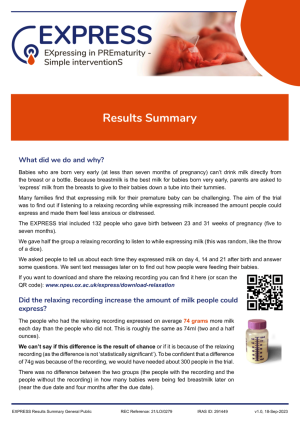
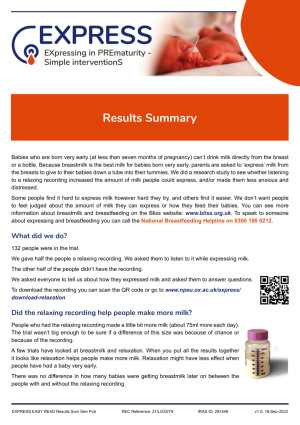
Show Plain Language Summary of Results
Show Relaxation Audio
Contact Us
No javascript available, can't display an interactive map.
- Name
- NPEU Clinical Trials Unit
- Address
- National Perinatal Epidemiology Unit (NPEU)
Nuffield Department of Population Health
University of Oxford
Old Road Campus
Oxford
OX3 7LF - ctu@npeu.ox.ac.uk
- Tel
- 01865 289700