


ToSCiN

Timing of Stoma Closure in Neonates
Trial started: 2020 Trial ended: 2022
Summary
Objectives
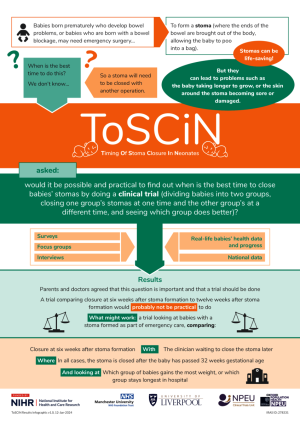
To determine if it is feasible to conduct a clinical trial comparing 'early' versus 'late' stoma closure in neonates.
Methods
A mixed-methods study comprising three parallel workstreams incorporating a clinician survey, prospective observational cohort study, parent interviews, focus groups, database analyses and a consensus meeting. The study was conducted in specialist neonatal surgical centres across the United Kingdom and involved neonatologists, neonatal surgeons, neonatal dietitians and neonatal nurses who care for neonates with stomas; neonates with a recent stoma, their parents and the clinicians looking after them; and three existing, overlapping clinical databases.
Results
One hundred and sixty-six professionals from all 27 neonatal surgical centres completed the survey: 6 weeks was the most common target time for stoma closure across clinical scenarios, although there was wide variation. Timing of closure was influenced by nutrition, growth and stoma complications.
The prospective cohort study enrolled 56 infants from 8 centres. Infants were mostly preterm with necrotising enterocolitis or intestinal perforation. Clinicians identified extreme preterm gestation and clinical conditions as reasons for not randomising babies into a hypothetical trial comparing early and late stoma closure. Parents and healthcare professionals identified that comparator arms needed more clinical flexibility in relation to timing of stoma closure.
Analysis of existing databases revealed wide variation in current timing of stoma closure in neonates and identified approximately 300 eligible infants for a trial per annum in the United Kingdom.
Conclusions
A trial of 'early' compared with 'late' stoma closure in neonates is feasible and is important to families and health professionals. The population of eligible babies in the United Kingdom is sufficient for such a trial. Challenges centre around lack of equipoise in certain scenarios, specifically: extremely preterm infants; infants waiting too long for stoma closure in the 'late' comparator; and logistical issues in closing a stoma at a trial-allocated time. These challenges are addressable by incorporating flexibility based on gestation at birth, communicating that both trial arms are standard practice and valid treatment options, and providing resources, for example, for operating lists.
Adapted from: Lansdale N, Woolfall K, Deja E, et al. Timing of Stoma Closure in Neonates: the ToSCiN mixed-methods study. Health Technology Assessment. 2024;28(71). https://doi.org/10.3310/JFBC1893. Licensed under the Creative Commons Attribution 4.0 International (CC BY 4.0) Licence (https://creativecommons.org/licenses/by/4.0/). Adapted for presentation on this website.
Show Publications
-
Lansdale N, Woolfall, K, Deja E, Mitchell T, Singhal G, et al. Timing of Stoma Closure in Neonates: the ToSCiN mixed-methods study. Health Technol Assess 2024;28(71)
https://doi.org/10.3310/JFBC1893 - Ducey J, Kennedy AM, Linsell L, Woolfall K, Hall NJ, Gale C, et al. Timing of neonatal stoma closure: a survey of health professional perspectives and current practice. Archives of Disease in Childhood - Fetal and Neonatal Edition. 2021:fetalneonatal-2021-322040.
http:// dx. doi. org/ 10. 1136/ archdischild2021- 322040
Show Plain Language Summary of Results
Contact Us
No javascript available, can't display an interactive map.
- Name
- NPEU Clinical Trials Unit
- Address
- National Perinatal Epidemiology Unit (NPEU)
Nuffield Department of Population Health
University of Oxford
Old Road Campus
Oxford
OX3 7LF - ctu@npeu.ox.ac.uk
- Tel
- 01865 289700