

SIFT

A multi-centre randomised controlled trial of two speeds of daily increment of milk feeding in very preterm or very low birth weight infants.
Trial started: 2013 Trial ended: 2019
Summary
Objectives
To determine whether faster (30 ml/kg/day) or slower (18 ml/kg/day) daily feed increments improve survival without moderate or severe disability and other morbidities in very preterm or very low-birthweight infants.
Methods
A multicentre, two-arm, parallel-group, randomised controlled trial conducted in 55 UK neonatal units between May 2013 and June 2015. Infants born at <32 weeks' gestation or weighing <1500 g who were receiving <30 ml/kg/day of milk at trial enrolment were randomised to receive daily feed increments of either 30 ml/kg/day or 18 ml/kg/day when clinicians were ready to start advancing feed volumes.
Outcome measures
Primary outcome: Survival without moderate or severe neurodevelopmental disability at 24 months' corrected age.
Secondary outcomes: Mortality; moderate or severe neurodevelopmental disability at 24 months corrected for gestational age; death before discharge home; microbiologically confirmed or clinically suspected late-onset sepsis; necrotising enterocolitis (Bell’s stage 2 or 3); time taken to reach full milk feeds (tolerating 150?ml/kg/day for 3 consecutive days); growth from birth to discharge; duration of parenteral feeding; time in intensive care; duration of hospital stay; diagnosis of cerebral palsy by a doctor or other health professional; and individual components of the definition of moderate or severe neurodevelopmental disability.
Results
A total of 1400 infants were allocated to faster feed increments and 1404 to slower feed increments. Survival without moderate or severe neurodevelopmental disability at 24 months occurred in 802 out of 1224 (65.5%) infants allocated to faster increments and 848 out of 1246 (68.1%) infants allocated to slower increments (adjusted risk ratio 0.96, 95% confidence interval 0.92 to 1.01). There was no significant difference between groups in the risk of the individual components of the primary outcome or in the important hospital outcomes: late-onset sepsis (adjusted risk ratio 0.96, 95% confidence interval 0.86 to 1.07) or necrotising enterocolitis (adjusted risk ratio 0.88, 95% confidence interval 0.68 to 1.16). Cost–consequence analysis showed that the faster feed increment rate was less costly but also less effective than the slower rate in terms of achieving the primary outcome, and was therefore not cost-effective. Four unexpected serious adverse events were reported, two in each group. None was assessed as being causally related to the intervention.
Conclusions
No clear advantage was identified for the important outcomes in very preterm or very low-birthweight infants when milk feeds were advanced in daily volume increments of 30 ml/kg/day or 18 ml/kg/day.
Adapted from: Dorling J, Hewer O, Hurd M, et al. Two speeds of increasing milk feeds for very preterm or very low-birthweight infants: the SIFT RCT. Health Technology Assessment. 2020;24(18). https://doi.org/10.3310/hta24180. © Queen's Printer and Controller of HMSO 2020. Adapted for presentation on this website.
Show Publications
-
Juszczak E, Hewer O, Partlett C, Hurd M, Bari V, Bowler U, et al. Evaluation of the effectiveness of an incentive strategy on the questionnaire response rate in parents of premature babies: a randomised controlled Study Within A Trial (SWAT) nested within SIFT. Trials. 2021;22(1):554.
https://doi.org/10.1186/s13063-021-05515-y - Dorling J, Hewer O, Hurd M, Bari V, Bosiak B, Bowler U,et al. Two speeds of increasing milk feeds for very preterm or very low-birthweight infants: the SIFT RCT. Health Technol Assess. 2020;24(18):1-94.
https://doi.org/10.3310/hta24180 - Dorling J, Abbott J, Berrington J, Bosiak B, Bowler U, Boyle E, et al. Controlled Trial of Two Incremental Milk-Feeding Rates in Preterm Infants. N Engl J Med. 2019;381(15):1434-43.
https://doi.org/10.1056/NEJMoa1816654 - The SIFT Investigators Group. Early enteral feeding strategies for very preterm infants: current evidence from Cochrane reviews. Arch Dis Child Fetal Neonatal Ed. 2013;98(6):F470-2.
http://www.ncbi.nlm.nih.gov/pubmed/23766343
-
Abbott J, Berrington J, Bowler U, Boyle E, Dorling J, Embleton N, et al. The Speed of Increasing milk Feeds: a randomised controlled trial. BMC Pediatr. 2017;17(1):39.
https://doi.org/10.1186/s12887-017-0794-z
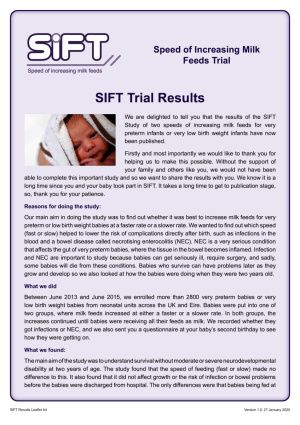
Show Plain Language Summary of Results
Contact Us
No javascript available, can't display an interactive map.
- Name
- NPEU Clinical Trials Unit
- Address
- National Perinatal Epidemiology Unit (NPEU)
Nuffield Department of Population Health
University of Oxford
Old Road Campus
Oxford
OX3 7LF - ctu@npeu.ox.ac.uk
- Tel
- 01865 289700