


E-Freeze

Freezing of embryos in assisted conception: a randomised controlled trial evaluating the clinical and cost-effectiveness of a policy of freezing embryos followed by thawed frozen embryo transfer, compared with a policy of fresh embryo transfer in women undergoing in vitro fertilisation.
Trial started: 2015 Trial ended: 2019
Summary
Objectives
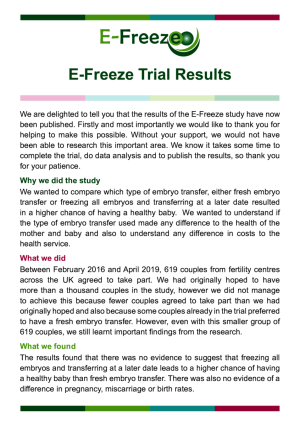
To evaluate whether a policy of freeze-all results in a higher healthy baby rate than the current policy of transferring fresh embryos.
Methods
A pragmatic, multicentre, two-arm, parallel-group, non-blinded, randomised controlled trial conducted in 18 in vitro fertilisation clinics across the UK between February 2016 and April 2019. Couples undergoing their first, second or third cycle of in vitro fertilisation treatment, in which the female partner was aged <42 years, were randomised to either freeze-all or fresh-embryo transfer if at least three good-quality embryos were present on day 3 of embryo development.
Outcome measures
Primary outcome: A healthy baby, defined as a live, singleton baby born at term, with an appropriate weight for gestation. Secondary outcomes: Ovarian hyperstimulation, live birth and clinical pregnancy rates, complications of pregnancy and childbirth, health economic outcome, and State–Trait Anxiety Inventory scores.
Results
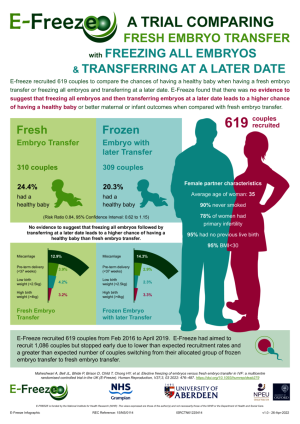
A total of 1578 couples were consented and 619 couples were randomised. Most non-randomisations were because of the non-availability of at least three good-quality embryos (n = 476). Of the couples randomised, 117 (19%) did not adhere to the allocated intervention. The rate of non-adherence was higher in the freeze-all arm, with the leading reason being patient choice. The intention-to-treat analysis showed a healthy baby rate of 20.3% in the freeze-all arm and 24.4% in the fresh-embryo transfer arm (risk ratio 0.84, 95% confidence interval 0.62 to 1.15). Similar results were obtained using complier-average causal effect, per-protocol and as-treated analyses. The risk of ovarian hyperstimulation was 3.6% in the freeze-all arm and 8.1% in the fresh-embryo transfer arm (risk ratio 0.44, 99% confidence interval 0.15 to 1.30). There were no statistically significant differences between the freeze-all and fresh-embryo transfer arms in live birth rates, clinical pregnancy rates or anxiety scores. The economic analysis showed that freeze-all had a low probability of being cost-effective in terms of the incremental cost per healthy baby and incremental cost per live birth.
Conclusions
When efficacy, safety and costs are considered, freeze-all is not better than fresh-embryo transfer.
Adapted from: Maheshwari A, Bari V, Bell JL, Bhattacharya S, Bhide P, Bowler U, et al. Transfer of thawed frozen embryo versus fresh embryo to improve the healthy baby rate in women undergoing IVF: the E-Freeze RCT. Health Technology Assessment. 2022;26(25). https://doi.org/10.3310/AEFU1104. © Maheshwari et al. 2022. Published by the NIHR Journals Library under the Creative Commons Attribution 4.0 International (CC BY 4.0) Licence (https://creativecommons.org/licenses/by/4.0/). Adapted for presentation on this website
Show Publications
-
Yangmei Li, Jenny McLeish, Pollyanna Hardy, Christina Cole, Claire Carson, Fiona Alderdice, Abha Maheshwari, Anxiety in couples undergoing IVF: evidence from E-Freeze randomised controlled trial, Human Reproduction Open, Volume 2024, Issue 3, 2024, hoae037
https://doi.org/10.1093/hropen/hoae037 - Maheshwari A, Bell JL, Bhide P, Brison D, Child T, Chong HY, et al. Elective freezing of embryos versus fresh embryo transfer in IVF: a multicentre randomized controlled trial in the UK (E-Freeze). Hum Reprod. 2022;37(3):476-87.
https://doi.org/10.1093/humrep/deab279 - Maheshwari A, Bari V, Bell JL, Bhattacharya S, Bhide P, Bowler U, Brison D, Child T, Chong HY, Cheong Y, Cole C, Coomarasamy A, Cutting R, Goodgame F, Hardy P, Hamoda H, Juszczak E, Khalaf Y, King A, Kurinczuk JJ, Lavery S, Lewis-Jones C, Linsell L, Macklon N, Mathur R, Murray D, Pundir J, Raine-Fenning N, Rajkohwa M, Robinson L, Scotland G, Stanbury K, Troup S. Transfer of thawed frozen embryo versus fresh embryo to improve the healthy baby rate in women undergoing IVF: the E-Freeze RCT. Health Technol Assess. 2022;26(25):1-142.
https://doi.org/10.3310/AEFU1104 - Bell JL, Hardy P, Greenland M, Juszczak E, Cole C, Maheshwari A, Bhattacharya S, Linsell L. E-Freeze - a randomised controlled trial evaluating the clinical and cost effectiveness of a policy of freezing embryos followed by thawed frozen embryo transfer compared with a policy of fresh embryo transfer, in women undergoing in vitro fertilisation: a statistical analysis plan. Trials. 2020;21(1):596.
https://doi.org/10.1186/s13063-020-04441-9
- Maheshwari A, Bhattacharya S, Bowler U, Brison D, Child T, Cole C, et al. Study protocol: E-freeze - freezing of embryos in assisted conception: a randomised controlled trial evaluating the clinical and cost effectiveness of a policy of freezing embryos followed by thawed frozen embryo transfer compared with a policy of fresh embryo transfer, in women undergoing in vitro fertilisation. Reprod Health. 2019;16(1):81. DOI: 10.1186/s12978-019-0737-2
Show Plain Language Summary of Results
Contact Us
No javascript available, can't display an interactive map.
- Name
- NPEU Clinical Trials Unit
- Address
- National Perinatal Epidemiology Unit (NPEU)
Nuffield Department of Population Health
University of Oxford
Old Road Campus
Oxford
OX3 7LF - ctu@npeu.ox.ac.uk
- Tel
- 01865 289700