


CORONIS

Prevention of maternal morbidity after caesarean section in developing countries: a factorial RCT of surgical methods.
Trial started: 2007 Trial ended: 2011
Summary
Objectives
To compare different surgical techniques used during caesarean section and determine whether any were associated with improved outcomes.
Methods
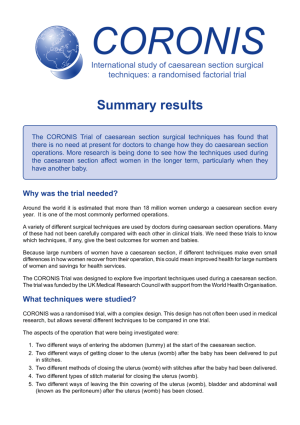
A pragmatic international randomised controlled trial conducted at 19 sites in Argentina, Chile, Ghana, India, Kenya, Pakistan and Sudan. Women undergoing their first or second caesarean section through a planned transverse abdominal incision were randomised to different combinations of surgical techniques. Five intervention pairs were evaluated: blunt versus sharp abdominal entry; exteriorisation of the uterus for repair versus intra-abdominal repair; single-layer versus double-layer uterine closure; closure versus non-closure of the peritoneum; and chromic catgut versus polyglactin-910 for uterine repair.
Outcome measures
Primary outcome: A composite of death, maternal infectious morbidity, further operative procedures or blood transfusion of more than one unit, assessed up to 6 weeks after caesarean section.
Results
A total of 15,935 women were recruited between May 2007 and December 2010. There were no statistically significant differences in the primary outcome for any of the five comparisons: blunt versus sharp abdominal entry (risk ratio 1.03, 95% confidence interval 0.91 to 1.17); exteriorisation versus intra-abdominal uterine repair (risk ratio 0.96, 95% confidence interval 0.84 to 1.08); single-layer versus double-layer uterine closure (risk ratio 0.96, 95% confidence interval 0.85 to 1.08); peritoneal closure versus non-closure (risk ratio 1.06, 95% confidence interval 0.94 to 1.20); and chromic catgut versus polyglactin-910 for uterine repair (risk ratio 0.90, 95% confidence interval 0.78 to 1.04). There were 144 serious adverse events, of which 26 were considered possibly related to the interventions. Most were recognised complications of surgery or of the conditions leading to caesarean section.
Conclusions
There was no evidence to favour one surgical technique over another for short-term outcomes. Longer-term follow-up was needed to determine whether differences between the techniques emerged over time.
Summary based on: CORONIS Collaborative Group, Abalos E, Addo V, et al. Caesarean section surgical techniques (CORONIS): a fractional, factorial, unmasked, randomised controlled trial. Lancet. 2013;382(9888):234–248. https://doi.org/10.1016/S0140-6736(13)60441-9.
Show Publications
-
CORONIS Collaborative Group, Abalos E, Addo V, Brocklehurst P, El Sheikh M, Farrell B, Gray S, Hardy P, Juszczak E, Mathews JE, Masood SN, Oyarzun E, Oyieke J, Sharma JB, Spark P. Caesarean section surgical techniques (CORONIS): a fractional, factorial, unmasked, randomised controlled trial. Lancet. 2013;382(9888):234-48.
http://www.ncbi.nlm.nih.gov/pubmed/23721753
-
Brocklehurst P, on behalf of the CORONIS Trial Collaborative Group. The CORONIS Trial: International study of caesarean section surgical techniques: a randomised fractional, factorial trial. BMC Pregnancy and Childbirth. [Protocol] 2007:7-24.
http://www.biomedcentral.com/1471-2393/7/24
Show Plain Language Summary of Results
Contact Us
No javascript available, can't display an interactive map.
- Name
- NPEU Clinical Trials Unit
- Address
- National Perinatal Epidemiology Unit (NPEU)
Nuffield Department of Population Health
University of Oxford
Old Road Campus
Oxford
OX3 7LF - ctu@npeu.ox.ac.uk
- Tel
- 01865 289700