

Innovative approach to the redesign of an under-recruiting RCT: lessons from the BASE trial
Published on Monday, 23 November 2026
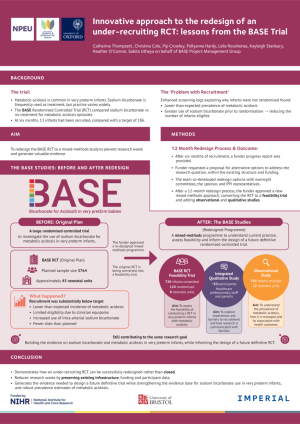
The BASE Trial Manager, Catherine Thompsett, presented a poster titled “Innovative approach to the redesign of an under-recruiting RCT: lessons from the BASE Trial” at this year's International Clinical Trials Methodology Conference (ICTMC).
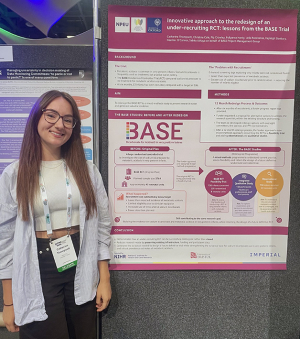
The poster outlines the rationale for the trial redesign, the process of obtaining approval for the proposed changes, the final approved design, and the importance of adapting trial designs to address recruitment challenges.
Read on to learn more about the BASE Trial redesign and view a copy of the poster below.
Why was a trial re-design needed?
The BASE Trial was originally designed as a randomised controlled trial (RCT) to investigate the use of sodium bicarbonate for metabolic acidosis in very preterm babies.
Recruitment to the trial began in February 2024. However, after six months, 13 babies had been recruited, compared with an anticipated target of 186 at that time. The overall recruitment target was 3764
To better understand the recruitment challenges, enhanced screening log data was collected to explore why babies were not being randomised. The findings showed a lower than expected prevalence of metabolic acidosis and greater use of sodium bicarbonate prior to randomisation, both of which reduced the number of eligible babies.
The process of redesigning the BASE Trial
After six months of recruitment, a progress report was submitted to the funder (NIHR HTA). In response to the recruitment challenges, the funder requested a proposal for alternative options to address the research question within the existing study structure and funding. The BASE team worked collaboratively with the study oversight committees, sponsor and Patient and Public Involvement (PPI) representatives to develop and refine potential redesign options.
The approved redesign
Following a 12-month process of development and review, the funder approved a revised study design.
The new design uses a mixed methods approach and is collectively called The BASE Studies. It includes:
- Feasibility Trial: Converting the original RCT into a feasibility trial to assess recruitment and adherence rates and inform the design of a future definitive trial.
- Observational Study: Investigating the prevalence of metabolic acidosis in very preterm babies, how it is managed in clinical practice, and its association with health outcomes.
- Qualitative Study: Exploring experiences of and barriers to recruitment, including how research is communicated to families.
Conclusion
The BASE Trial redesign demonstrates how adapting a trial in response to recruitment challenges can enable important research to continue, minimise research waste and maximise the value of existing investment.
By adopting a mixed-methods approach, The BASE Studies will generate valuable evidence on the management of metabolic acidosis, improve understanding of recruitment barriers, and inform the feasibility and design of a future definitive trial.
The experience of redesigning the BASE Trial provides valuable lessons for other research teams facing similar recruitment challenges and demonstrates the importance of flexibility and collaboration in clinical trial delivery.
NPEU News

OxPop News