

Information for Clinicians
Background
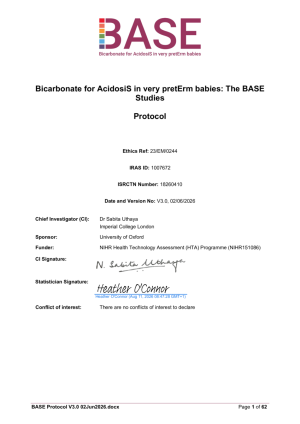
The BASE Studies uses a mixed methods design to improve our understanding of metabolic acidosis in very preterm babies, it's management with sodium bicarbonate and the feasibility of conducting a future large randomised controlled trial.
The studies include the original BASE Randomised Controlled Trial (RCT) and three workstreams; a randomised feasibility study, an observational study and an integrated qualitative study.
BASE Trial & Feasibility Study
Trial Design
The original BASE RCT is a multicentre, pragmatic, open-label, two-arm, parallel-group randomised controlled trial investigating the use of sodium bicarbonate for metabolic acidosis in very preterm babies.
Following lower-than-expected recruitment, the RCT was adapted to include a randomised feasibility trial to better understand whether a future definitive RCT can be successfully delivered.
Babies are randomised to one of two approaches, both of which reflect current UK clinical practice:
- Routine use of sodium bicarbonate infusion for episodes of metabolic acidosis
- No routine use of sodium bicarbonate infusion for episodes of metabolic acidosis
The trial aims to recruit 110 across the original BASE RCT and the feasibility trial.
What is the feasibility trial assessing?
The feasibility trial aims to assess whether it is feasible to conduct a randomised controlled trial in very preterm babies with metabolic acidosis.
The trial will focus on two key measures:
- Recruitment rate: the proportion of eligible babies screened and consented who are successfully randomised into the trial.
- Adherence rate: the proportion of randomised babies who adhere to their allocated treatment arm.
Inclusion Criteria
- Babies born between 23+0 and 30+6 weeks+days of gestation inclusive
- Postmenstrual age less than 34+0 weeks+days
- Metabolic acidosis defined as blood pH less than 7.2 (optionally between 7.20 and 7.25) with pCO2 that is low or normal for the clinical context and a low bicarbonate level
- The parent's verbal consent for the baby to participate in the trial has been documented in the baby's medical notes and Investigator Site File (ISF)
Exclusion Criteria
- Life-threatening condition, or significant congenital anomaly
- Inborn error of metabolism (known or under active investigation)
- Prior treatment with sodium bicarbonate unless in the context of cardiopulmonary resuscitation or if used as a substitute for normal saline in arterial line infusion
- Current episode of metabolic acidosis immediately follows cardiopulmonary resuscitation.
BASE Observational Study
The Observational Study is a multicentre, prospective, cohort study.
The study aims to investigate the prevalence of metabolic acidosis in very preterm babies and the association of the use of sodium bicarbonate with health outcomes in the short term.
The study will collect information on
- how often metabolic acidosis occurs in very preterm babies
- how it is treated in routine clinical practice
- whether there is any association between treatment and health outcomes.
Around 750 babies will be enrolled in approximately 22 neonatal units in the UK over a 9 month period.
Inclusion criteria
- Babies born between 23+0 and 30+6 weeks+days of gestation inclusive
- Born at a recruiting site or transferred within 24 hours of being born
Exclusion criteria
- A parent has opted out of their baby's participation
Qualitative QuinteT Study
The integrated qualitative study is being conducted by the QuinteT research group, based at the University of Bristol.
The study aims to understand how metabolic acidosis is currently managed in neonatal units across the UK. It will also explore the factors that may support or challenge the successful delivery of the BASE Trial, as well as parents' experiences of being invited to consider taking part.
The study will involve:
- Interviews with healthcare professionals
- Interviews with parents
- Audio-recordings of conversations between healthcare professionals and families about taking part in the BASE Trial
The findings will help us better understand the challenges around recruitment, identify ways to improve the delivery of the BASE Trial, and support clear and effective communication with families about the research. These insights will also help inform the design and delivery of a future definitive trial.